
Introduction
Over the past few months, headlines and social media discussions have sparked a growing concern—India’s GDP ranking has slipped on the global stage. For a country that has consistently been projected as one of the fastest-growing major economies, this news has raised eyebrows.
At first glance, it seems like a warning sign. Has India’s growth story started to slow down? Is the economy losing its momentum just when it was expected to take off?
But before jumping to conclusions, it’s important to pause and understand what GDP rankings actually represent—and more importantly, what they don’t.
The reality is that global GDP rankings are influenced by more than just economic growth. Factors like currency fluctuations, global market dynamics, and exchange rate movements can significantly impact how economies are perceived on paper.
So the real question isn’t just “Is India slowing down?” but rather;
Quick Summary
• India’s GDP hasn’t actually shrunk
• The ranking drop is mainly due to rupee depreciation
• Dollar-based comparisons can distort reality
• India’s long-term growth fundamentals remain strong
What Happened to India’s GDP Ranking?
India, which had previously overtaken the UK in global GDP rankings, now appears to have slipped back. At first glance, this may suggest economic weakness.
However, this interpretation can be misleading. GDP rankings are not determined by growth alone—they are also influenced by exchange rates, which can significantly change how economies are compared globally.

Understanding GDP Rankings: Why Currency Matters
Every country calculates its GDP in its own currency. In India’s case, GDP is measured in rupees. However, global comparisons are made using US dollars.
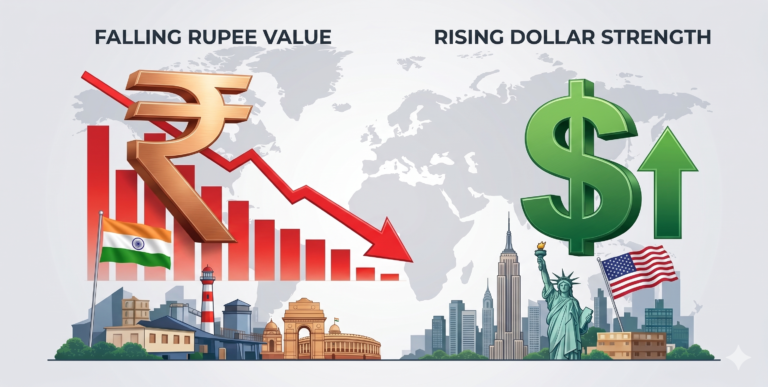
This creates a dependency on exchange rates. When the rupee weakens against the dollar, India’s GDP appears smaller in global terms—even if the economy is growing in reality.
How GDP is Calculated Globally
To compare economies globally, GDP is converted into a common currency, usually the US dollar. This allows analysts and institutions to rank countries based on economic size.
However, this method introduces a key issue: exchange rates can fluctuate due to many factors unrelated to actual economic growth.
Why Currency Movements Play a Huge Role
Exchange rates are influenced by multiple factors such as global demand for currencies, inflation, interest rates, and geopolitical conditions.
When the US dollar strengthens globally, many emerging market currencies—including the Indian rupee—tend to weaken.
This has a direct impact on GDP rankings.
For example:
- If India’s GDP grows by 6% in rupee terms
- But the rupee depreciates significantly against the dollar
- The growth may not fully reflect in dollar terms
As a result, India’s global ranking might appear stagnant or even decline.
Rupee Depreciation in 2026: The Real Reason Behind the Drop
During the financial year 2025–26, the Indian Rupee weakened significantly against the US dollar. This depreciation had a direct impact on India’s GDP when measured in dollar terms.
Even if economic activity remained stable, the lower value of the rupee reduced the overall GDP figure in global comparisons, creating the impression of a decline.
What Changed in FY 2025–26
In FY 2025–26, multiple economic pressures contributed to the weakening of the rupee. Global financial conditions, rising import costs, and capital outflows all played a role in increasing demand for the US dollar.
Impact on India’s Global Position
As the rupee weakened, India’s GDP appeared smaller when converted into dollars. This directly affected its position in global rankings, even though the domestic economy continued to grow.
Real Example: How Currency Changes GDP in Dollar Terms
Consider an example where India’s GDP remains the same in rupee terms. If the exchange rate changes from ₹83 per dollar to ₹93 per dollar, the total GDP in dollars automatically decreases.
This shows that even without any real change in economic output, the global perception of the economy can shift significantly due to currency movements.
A Simple Example That Changes Everything
Let’s simplify this with a relatable example.
Imagine India produces goods and services worth ₹100.
- At an exchange rate of ₹80 per dollar → GDP = $1.25
- At an exchange rate of ₹100 per dollar → GDP = $1
Nothing changed in terms of production. No factories closed. No jobs disappeared.
But globally, it looks like the economy has shrunk.
Foreign Investment Outflows
When foreign investors withdraw their money from Indian markets, they convert rupees into dollars. This increases demand for the dollar and weakens the rupee.
Increase in Gold Imports
India has a strong demand for gold, and higher imports mean more dollars are required. This contributes to additional pressure on the rupee.
Global Economic Uncertainty
Global events such as changes in US interest rates, geopolitical tensions, and economic uncertainty can impact currency markets. These factors often lead to a stronger dollar and a weaker rupee.
How Global GDP Rankings Are Calculated
To compare economies across the world, institutions like the IMF and World Bank convert GDP into US dollars using current exchange rates.
While this method ensures standardization, it also introduces volatility.
Let’s break it down:
- Country A grows steadily but its currency weakens
- Country B grows slowly but its currency remains strong
In dollar terms, Country B might appear stronger—even if its real economic activity is lower than Country A.
Is India’s Economy Actually Slowing Down?
let’s address the most important question.
Is India’s economy really slowing down?
The answer is not as straightforward as headlines suggest India continues to show strong growth fundamentals:
India continues to show strong growth fundamentals:
According to IMF projections https://www.imf.org/en/Publications/WEO India is expected to remain one of the fastest-growing major economies in the world, even amid global uncertainties.
Rising Digital Economy: India is one of the fastest-growing digital markets…
Infrastructure Development: Massive investments…
Startup Ecosystem: India has become…
- Rising Digital Economy: India is one of the fastest-growing digital markets in the world, with increasing internet penetration and digital payments adoption.
- Infrastructure Development: Massive investments in roads, railways, and urban development are boosting long-term productivity.
- Startup Ecosystem: India has become one of the largest startup hubs globally, attracting significant investment and innovation.
- Domestic Consumption: A large and growing middle class continues to drive demand across sectors.
While there may be short-term challenges such as inflation, global uncertainty, or policy adjustments, the overall growth trajectory remains positive.
The Role of Global Economic Conditions
It’s also important to understand that India does not operate in isolation.
Global economic conditions play a major role in shaping outcomes.
Factors such as:
- US interest rate hikes
- Global inflation
- Supply chain disruptions
- Geopolitical tensions
..can all influence currency values and economic performance.
When the US Federal Reserve raises interest rates, the dollar often strengthens. This puts pressure on currencies like the rupee.
GDP vs Real Economic Progress
One of the biggest mistakes people make is equating GDP rankings with overall economic health.
But real economic progress goes far beyond rankings.
Key indicators that truly matter include:
- Employment generation
- Income growth
- Business expansion
- Innovation and technology adoption
- Standard of living
A country can drop in GDP rankings and still improve in all these areas.
My Take: The Ranking Obsession Is Misleading
In my view, too much emphasis is placed on global rankings. While they are useful for comparison, they do not capture the full picture of an economy’s strength.
India’s growth story is driven by structural factors—demographics, consumption, and innovation. These are long-term drivers that cannot be fully reflected in short-term ranking changes.
Instead of asking “What is India’s rank?” we should be asking:
“Is India creating opportunities, jobs, and sustainable growth?”
Because that’s what truly defines economic success.
What Should You Really Focus On?
If you’re someone interested in business, investing, or understanding the economy, here’s what you should pay attention to instead of just GDP rankings:
- Growth rate (Is the economy expanding?)
- Sector performance (Which industries are growing?)
- Government policies (Are they supporting growth?)
- Global trends (How is the world economy behaving?)
These factors give a much clearer picture than rankings alone.
Conclusion: Are We Measuring Growth the Right Way?
So, is India’s GDP drop a sign of economic trouble?
Not necessarily.
In many ways, it highlights a deeper issue—how we measure and interpret economic performance.
GDP rankings are influenced by currency movements, global conditions, and external factors that don’t always reflect ground reality.
India’s economy continues to grow, evolve, and expand in key areas. The fundamentals remain strong, even if the rankings fluctuate.
The real question is not whether India is slowing down.
The real question is: Are we looking at the right indicators to judge growth?
FAQs
Q1: Why did India’s GDP ranking drop in 2026?
India’s GDP ranking dropped mainly due to rupee depreciation against the US dollar, not because of a major slowdown in the economy.
Q2: Is India’s economy slowing down?
No, India’s economy is still growing, but global factors and currency movements affect how it appears in rankings.
Q3: How does rupee vs dollar affect GDP?
GDP is converted into US dollars for global comparison. A weaker rupee reduces the GDP value in dollar terms.
Q4: Should we worry about GDP ranking?
Not always. Rankings don’t fully reflect real economic growth, jobs, or development.