
Introduction
My freshman roommate blew through his entire semester’s allowance by October. Books, late-night pizza, random Amazon impulse buys gone. He spent the last two months eating dining hall ramen and borrowing bus money. Sound familiar? Honestly, most college students hit that wall at some point.
College budgeting is one of those skills nobody really teaches you before you move out. You figure it out the hard way or you read a guide like this one and skip the painful part.
This post walks you through everything: how to build a realistic budget, where most students leak money without realizing it, which apps actually help, and how to stay on track when life gets messy. By the time you finish reading, you’ll have a real plan not just vague advice.

Why College Budgeting Actually Matters
Let’s be real college is expensive. Tuition, rent, food, textbooks, subscriptions you forgot you signed up for. It adds up faster than you’d expect.
But here’s what most people get wrong: budgeting isn’t about being broke and miserable. It’s about spending intentionally. When you know where your money goes, you stop feeling anxious every time you check your bank account.
Students who practice college budgeting early also build habits that stick for life. According to NerdWallet, people who budget consistently are more likely to hit financial goals whether that’s paying off student loans faster or saving for their first apartment after graduation.
Starting now, even imperfectly, beats starting at 30 with zero financial skills.
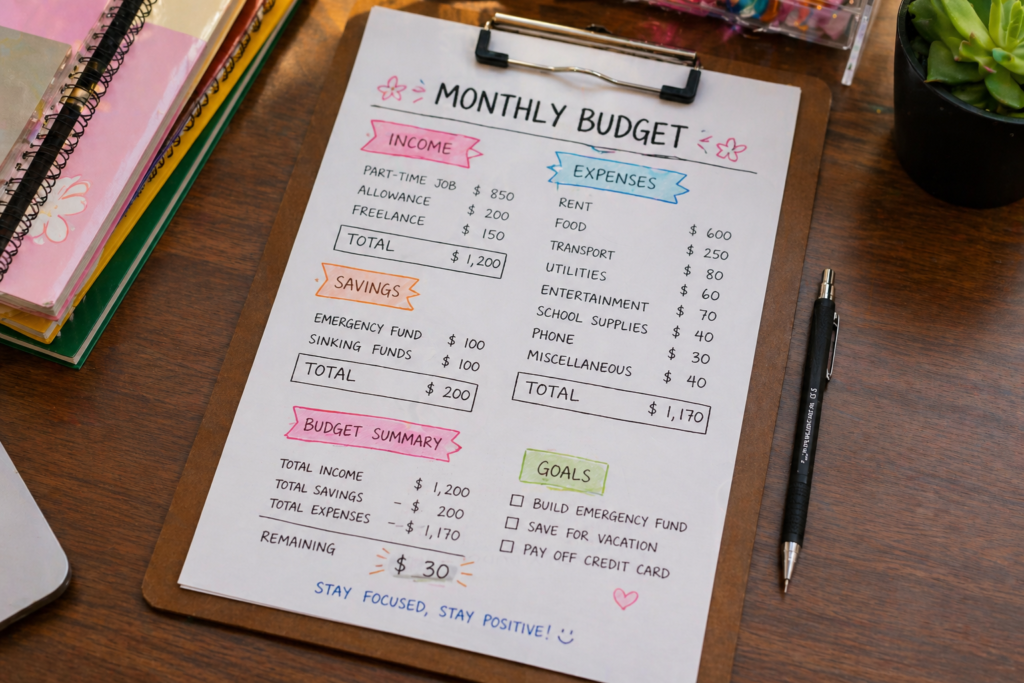
How to Build Your First College Budget
Building a budget sounds intimidating. It’s not. Here’s a simple step-by-step:
Step 1: Track All Your Income
List every source of money coming in each month:
- Parental support or family transfers
- Part-time job income
- Scholarships or financial aid disbursements
- Side gigs (tutoring, freelancing, etc.)
Write the total. That’s your monthly ceiling.
Step 2: List All Fixed Expenses
These are costs that don’t change:
- Rent or dorm fees
- Phone bill
- Subscriptions (Netflix, Spotify, etc.)
- Loan repayment (if applicable)
Step 3: Estimate Variable Expenses
These change month to month:
- Groceries and dining
- Transportation (bus, Uber, gas)
- Clothing and personal care
- Social activities and entertainment
Step 4: Do the Math
Subtract total expenses from total income. If the number is negative, you need to cut somewhere. If it’s positive great, that’s your saving space.
Simple. Honest. Effective.
The 50/30/20 Rule Does It Work for College Budgeting?
The 50/30/20 rule is a popular framework: 50% of income on needs, 30% on wants, 20% on savings or debt repayment.
Here’s a quick look at how it maps to student life:
| Category | % of Income | Student Example |
|---|---|---|
| Needs | 50% | Rent, food, textbooks, transport |
| Wants | 30% | Dining out, entertainment, clothes |
| Savings | 20% | Emergency fund, loan payoff |
Does it work perfectly for college students? Not always. If you’re living in an expensive city or your income is irregular, the percentages might need adjusting. Think of it as a starting framework, not a strict law.
Even flipping it slightly 60% needs, 20% wants, 20% savings can work well depending on your situation.

Best Budgeting Apps for College Students
You don’t need a spreadsheet if you hate spreadsheets. These apps make college budgeting almost effortless:
- Mint – Free, syncs with your bank, auto-categorizes spending
- YNAB (You Need A Budget) – Great for people serious about zero-based budgeting; free for students
- Goodbudget – Envelope-style budgeting, works well for visual learners
- Splitwise – Perfect for splitting rent and bills with roommates
- Google Sheets – Old school, but fully customizable and free
The best app is whichever one you’ll actually open. Start simple.
For more financial tools and resources built for young adults, you can also explore NextGenDecode it covers practical money and lifestyle topics for students and young professionals.
Where Students Waste Money (And How to Stop)
This section might sting a little. Most students waste money in the same predictable places:
- Unused subscriptions – Check your bank statement. Seriously. Right now.
- Eating out too often – One coffee a day = ₹3,000–₹4,000/month gone
- Impulse online shopping – Those “Add to Cart” sessions at midnight are brutal
- Buying new textbooks – Rent them, buy used, or find PDFs
- ATM fees – Use your bank’s ATM or switch to a zero-fee account
The fix isn’t perfection. It’s awareness. Once you see the pattern, you can make a small change and save real money.
Pros and Cons of Strict Budgeting in College
Pros
- Reduces financial stress significantly
- Builds discipline and long-term money habits
- Prevents debt from snowballing
- Frees up money for things that matter to you
- Makes you more confident with money decisions
Cons
- Can feel restrictive at first
- Requires consistent tracking (takes effort)
- Unexpected expenses can throw off your plan
- Social pressure to spend can make it hard to stick to
The bottom line? The pros easily outweigh the cons especially when you realize that a little discipline now saves you from years of financial stress later. According to Investopedia, budgeting is one of the foundational habits of long-term financial health.

Practical Tips to Stick to Your College Budgeting Plan
Knowing what to do and actually doing it are two different things. Here’s what works:
- Set a weekly money check-in – 10 minutes every Sunday. Review spending, adjust if needed.
- Use cash for “want” spending – Physical money feels more real than a card swipe.
- Create a “fun fund” – Budget a guilt-free amount for socializing so you don’t feel deprived.
- Automate savings – Even ₹500/month adds up. Set up an auto-transfer on payday.
- Tell a friend your goals – Accountability is underrated.
- Give yourself grace – You’ll mess up some months. Reset and continue.
Small, consistent actions beat perfect plans every time.
Conclusion
College budgeting doesn’t require you to become a finance expert overnight. It just requires you to pay a little attention to what’s coming in, what’s going out, and where you want to end up.
Start with a basic income-expense list. Pick one app. Cut one unnecessary expense this week. That’s it. Small steps create real momentum.
The students who graduate without crushing debt aren’t luckier than you they just made slightly smarter choices, consistently. You can do the same. Your future self will genuinely thank you.
FAQ: College Budgeting Questions Answered
Q1: How much should a college student budget per month?
It depends on your city and lifestyle, but a reasonable estimate ranges from ₹8,000–₹20,000/month for living expenses (excluding tuition). Track your actual spending for one month to find your real baseline.
Q2: What is the best budgeting method for college students?
The 50/30/20 rule is a great starting point. For tighter budgets, zero-based budgeting (where every rupee is assigned a job) works very well.
Q3: How can I save money in college without feeling miserable?
Budget for fun. Seriously include entertainment and social spending in your plan. Restriction without any reward leads to giving up.
Q4: Are budgeting apps safe for college students to use?
Yes, reputable apps like Mint, YNAB, and Goodbudget use bank-level encryption. Always use apps with strong reviews and avoid sharing passwords.
Q5: How do I stick to my college budget when friends pressure me to spend?
Be honest with close friends most will respect it. Have low-cost alternatives ready (home movie nights, cooking together, campus events). You don’t have to explain your budget to anyone.
“Subscribe to mydecodeletter for weekly decodes”