
Introduction
I once spent three months building an app nobody asked for. The design was clean. The features were solid. But when I launched it, barely ten people signed up. That stung badly. The problem was not the product. The problem was I never tested if anyone actually wanted it.
Business idea validation is the step most new entrepreneurs skip. They get excited, dive in fast, and waste real money on something the market does not want. This post walks you through 8 key steps to test your business idea before spending a single rupee. You will learn how to talk to real customers, test demand, and build with confidence.
Table of Contents

Why Business Idea Validation Changes Everything
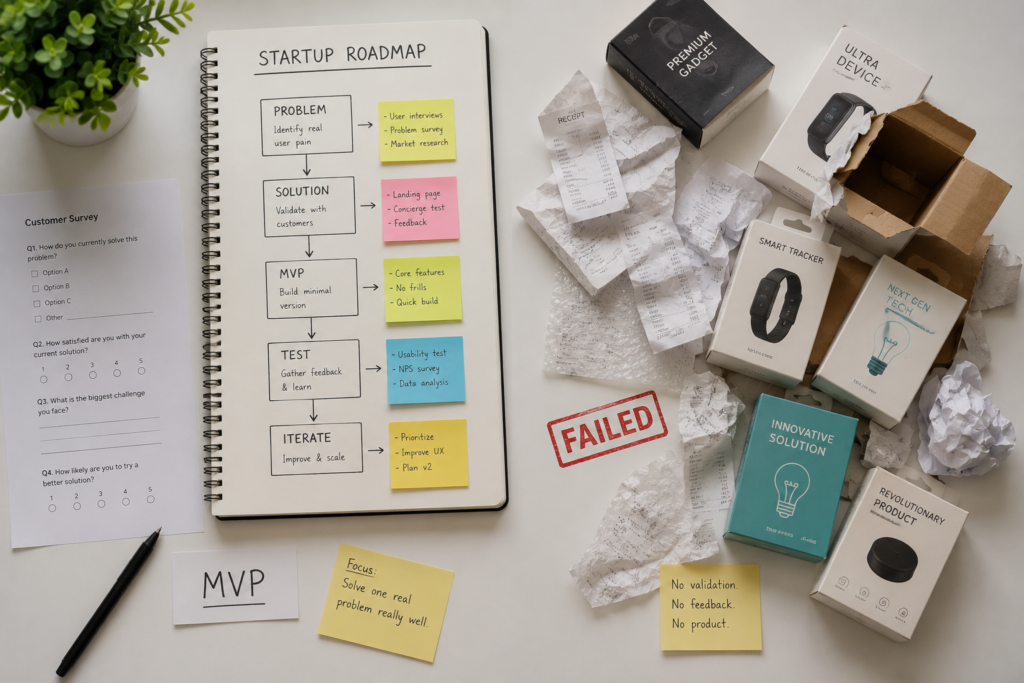
Most businesses fail not because of bad execution but because of bad assumptions. When you skip business idea validation, you are betting your time, money, and energy on a guess. And guesses are expensive.
According to Forbes, over 90% of startups fail, and one of the top reasons is building something the market does not need. Validation flips that risk on its head. It forces you to test your assumptions early, when changes are cheap and fast.
Think of validation as a filter. It removes bad ideas before they drain you. It sharpens good ones into something people will actually pay for. When you validate first, you move from guessing to knowing.
8 Key Steps for Smart Business Idea Validation
Step 1: Define the Real Problem You Are Solving
Every great business solves a real problem. Before anything else, write down the exact problem your idea addresses. Be specific. “People waste time” is too vague. “Freelancers in India lose 3 hours a week chasing invoice payments” is something you can test.
Ask yourself:
- Who exactly has this problem?
- How often do they face it?
- Are they already trying to solve it somehow?
If you cannot clearly define the problem, you are not ready to build anything yet.
Step 2: Talk to Real People Before Building Anything
This is the most powerful and most skipped step. Customer discovery interviews are simply conversations with the people you want to serve. You ask them about their life, their challenges, and their habits.
Do not pitch your idea yet. Just listen. You are trying to understand their pain, not sell your solution. Aim for at least 10-15 conversations. You will be surprised how quickly patterns start to show up.
Keep these questions handy:
- “What is the hardest part of [problem area] for you?”
- “How do you handle it now?”
- “How much time or money does this cost you?”
Step 3: Run a Simple Business Idea Validation Survey
Once you have spoken to a few people, a short online survey helps you scale those conversations. Use tools like Google Forms or Typeform. Keep it under 5 questions.
The goal is to check if the pain you discovered in your interviews is common. If 70% of respondents confirm the same problem, you have real signal. If responses are scattered and unclear, the problem may not be as painful as you thought.
This step is a fast and free way to do business idea validation at scale.
Step 4: Analyze Your Competition Honestly
Competition is actually good news. It means a market exists. Look at what others are offering, where they fall short, and what customers are complaining about in their reviews.
Use these sources:
- Google Play / App Store reviews
- Reddit threads and Quora questions
- G2 and Capterra for software products
- Amazon reviews for physical products
If there is no competition at all, be careful. It might mean there is no demand either.
Step 5: Build a Minimum Viable Product (MVP)
An MVP is the simplest version of your product that can still deliver value. It is not a rough draft. It is a focused, working version that tests your core assumption.
You do not need to code a full app. A well-designed landing page, a WhatsApp group, or even a manual service done by hand can be your MVP. The point is to deliver the value and see if people use it.
According to Wikipedia’s page on lean startup methodology, the build-measure-learn loop is the foundation of smart product development. Build small, learn fast.
Step 6: Test Willingness to Pay
This is where many validators get stuck. Getting people to say “I love this idea!” is easy. Getting them to open their wallet is the real test.
Try these methods:
- Pre-sell: Offer early bird access at a discounted price before you fully build
- Paid pilot: Charge a small fee for a beta version or early access
- Crowdfunding: Use Kickstarter or Indiegogo to test real demand with real money
If nobody pays, that is data too. It means the idea needs adjustment before you invest more.
Step 7: Launch a Landing Page and Track Results
A one-page website explaining your product, its benefits, and a signup or buy button is one of the smartest startup idea testing tools available. It costs almost nothing to set up and tells you a lot.
Track:
- How many people visit
- How many sign up or click “Buy”
- Where they drop off
A 5-10% conversion rate on signups is a strong early signal. If it is under 1%, revisit your messaging or the idea itself.
Step 8: Review, Rethink, and Refine
Validation is not a one-time event. After every test, sit down and ask what you learned. What worked? What surprised you? What needs to change?
Some ideas need a small pivot. Others need a full rethink. That is completely okay. The goal of validation is not to confirm your idea is perfect. The goal is to find the version of your idea that the market actually wants.

Validated vs Unvalidated Business Ideas (Comparison)
| Factor | Validated Idea | Unvalidated Idea |
|---|---|---|
| Customer proof | Yes, confirmed by real conversations | Based on assumption only |
| Money spent before launch | Minimal, tested with low-cost methods | Often high, full product built first |
| Market demand | Proven through surveys and pre-sales | Unknown and unconfirmed |
| Time to first feedback | Days to weeks | Months after launch |
| Risk of failure | Significantly reduced | Very high |
| Pivot ability | Easy, caught early | Expensive and painful |
| Investor confidence | Higher, with real data | Lower, pitch based on idea alone |
Pros and Cons of Validating Your Business Idea
Pros of Business Idea Validation
- Saves money: You discover bad ideas before spending big on development
- Saves time: Weeks of testing beats months of building the wrong thing
- Builds confidence: Real data gives you something concrete to act on
- Attracts investors: Data-backed ideas are far more fundable than guesswork
- Reduces emotional bias: Validation forces you to listen to the market, not just your gut
- Improves product-market fit: You build what people actually want
Cons of Business Idea Validation
- Takes time upfront: Running surveys and interviews adds a few weeks before you start building
- Can feel slow: Impatient founders may resist the process
- Risk of analysis paralysis: Some people validate endlessly and never launch
- Feedback can be misleading: People say they would pay, but then do not act when the time comes
- Requires skill to interpret: Bad survey questions lead to useless data
Practical Guide: How to Start Validating Your Idea Today
Ready to get going? Here is a simple action plan you can start today:
- Write a one-paragraph problem statement – who has it, how often, and what they lose because of it
- List 10 people who match your target customer and message them to schedule a 15-minute call
- Create a 5-question Google Form and share it in 3 relevant WhatsApp or Facebook groups
- Build a free landing page using Carrd or Framer with a “Join the waitlist” button
- Check Google Trends to see if search interest in your topic is growing
- Set a validation deadline – give yourself 2-3 weeks and make a go/no-go decision based on data
For more tips on building smart businesses from scratch, explore the full resource library at NextGenDecode. It is built specifically for Indian entrepreneurs who want to build with clarity, not chaos.

Conclusion
Starting a business without validation is like driving blindfolded. These 8 steps exist to remove that blindfold before you invest real money and real time.
You now know how to define the problem, talk to customers, survey your audience, study competition, build an MVP, test willingness to pay, track landing page results, and keep refining. Each step is simple. Together, they are powerful.
Here is the clearest advice: pick one step and do it today. Not next week. Today. Even one customer interview teaches you more than a month of planning alone.
Your idea might be exactly what the market needs. But you will only know for sure once you test it. Go find out.
Frequently Asked Questions About Business Idea Validation
Is business idea validation really necessary for small businesses?
Yes, absolutely. Many small business owners think validation is only for tech startups. But it applies to every type of business. Whether you are opening a bakery or launching a tutoring service, testing demand before investing saves you from a very costly mistake. Even one week of customer conversations can completely change your approach.
How long does it take to validate a business idea?
Most ideas can go through a basic validation process in 2 to 4 weeks. Customer interviews, a short survey, and a simple landing page test can all be done in that timeframe. The goal is not to be perfect before launching. The goal is to gather enough real signal to make a confident decision.
What is the cheapest way to validate a startup idea?
The cheapest and fastest method is direct conversation. Message 10 to 15 people who match your target audience. Ask them about the problem. No app needed, no money needed. After that, a free Google Form survey and a free Carrd landing page are your next best zero-cost tools for business idea validation.
Can I validate a business idea without building a product?
Absolutely yes. In fact, that is the whole point. You can test demand using a landing page, a pre-sale offer, a survey, or even a simple PDF explainer sent to potential customers. Validation happens before the product. Building before validating is one of the most common and expensive startup mistakes.
What happens if my business idea fails validation?
That is actually a win. Finding out an idea will not work costs you two weeks. Not finding out costs you two years and your savings. A failed validation means you now know to pivot, tweak the target audience, or look for a different problem to solve. Treat every result as data, not defeat.
Published on NextGenDecode.in | Your guide to building smart businesses