
Table of Contents
Introduction: Why Your Brain Is Working Against Your Wallet
Picture this. You open your banking app on Sunday morning. You planned to save ₹5,000 this month. But somehow, between food orders, random online shopping, and a “small” impulse buy, it’s gone. Again.
This is not a discipline problem. This is spending vs saving psychology at work. Your brain has real, biological reasons for choosing the quick reward over the future benefit. And once you understand those reasons, you stop blaming yourself and start actually changing.
This post breaks down 9 proven psychological truths behind why you spend, why saving feels unnatural, and what you can do to flip the script starting today.
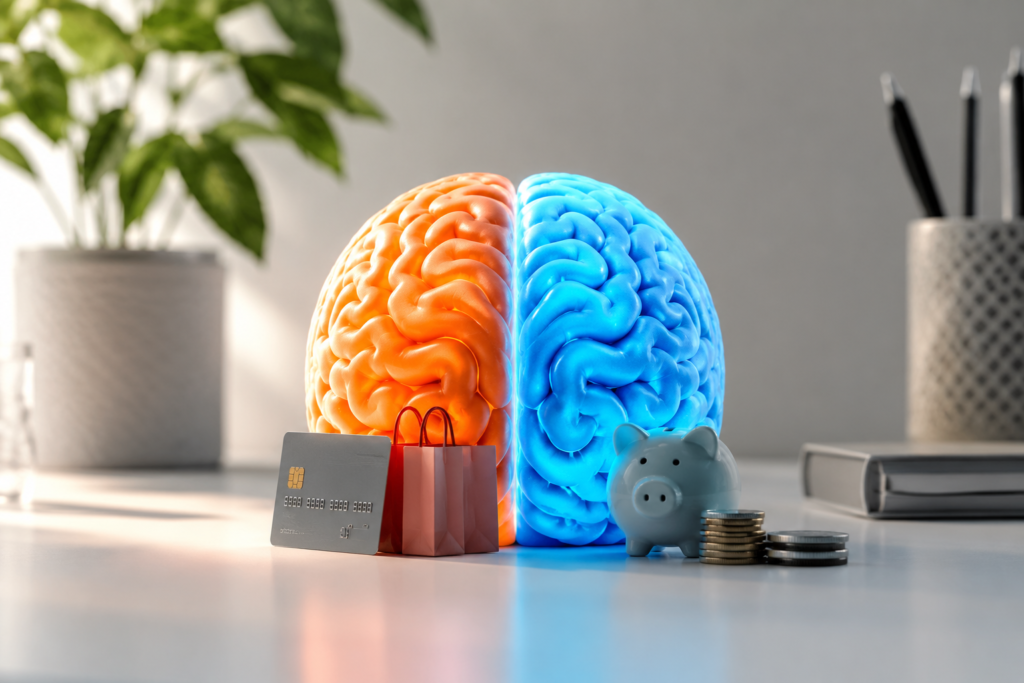
What Is Spending vs Saving Psychology?
Spending vs saving psychology is the study of why humans make the financial choices they do. It sits right at the crossroads of behavioral economics and neuroscience. It’s not about math. It’s about emotion, habit, and how your brain is wired.
According to research featured on Psychology Today, most financial decisions are made in the emotional part of the brain, not the logical one. This means your feelings often take the wheel before your spreadsheet ever gets a chance.
Simply put, your brain was built for survival, not for building a savings account. Understanding this changes everything.
The 9 Smart Truths Behind Spending vs Saving Psychology
Your Brain Loves Instant Rewards
Your brain has a built-in preference called present bias. It means you value something you can have right now much more than something you will have in the future. A ₹1,000 reward today feels bigger than ₹1,500 in three months. This is why “buy now, pay later” schemes work so well. They let you feel the reward instantly while pushing the pain far into the future.
Dopamine Makes Spending Feel Like Winning
Every time you buy something, your brain releases dopamine, the feel-good chemical. Even the act of browsing online stores can trigger a small dopamine hit. This is not a coincidence. Retailers and app designers know exactly how this works. The notification, the countdown timer, the “limited offer” badge, all of these are designed to trigger your brain’s reward system and make spending feel like winning.
Saving Feels Like Losing (But It Isn’t)
Here’s the uncomfortable truth behind spending vs saving psychology: saving genuinely feels like loss to your brain. When you don’t spend money, your brain registers it as giving something up. Psychologists call this loss aversion. You feel the pain of losing ₹500 almost twice as strongly as the pleasure of gaining ₹500. So when you move money to savings, your brain quietly says “that hurts.” No wonder it’s hard.
Social Pressure Drives More Spending Than You Think
Humans are social creatures. Your spending is heavily influenced by the people around you. This is called social comparison theory. When a friend buys a new phone, you suddenly notice your old one more. When colleagues go out for expensive lunches, skipping it feels awkward. According to NerdWallet, nearly 40% of millennials admit to spending money they didn’t have because of social pressure. That number is probably higher than people admit.
The Scarcity Mindset Keeps You Stuck
A scarcity mindset around money makes you focus on what you don’t have rather than what you can build. This mental pattern often leads to impulsive spending as a form of emotional escape. Ironically, the less money you feel you have, the harder it becomes to think clearly about saving it. Scarcity hijacks your mental bandwidth and makes short-term decisions feel like the only option.
Emotional Spending Is Real and It Is Costly
Stress, boredom, loneliness, and even happiness can all trigger spending. Emotional spending happens when you use shopping as a mood fix. The relief is real but short-lived. And then the guilt arrives. This cycle can drain your finances faster than any large purchase. Recognizing your emotional triggers is one of the most important steps in changing your financial behavior.
Automation Is the Smartest Saving Hack
Your brain will always try to spend what it can see. But what it can’t see, it won’t miss. Automating your savings removes the decision entirely. When money moves to savings before you even touch it, you never have to fight your brain’s spending instinct. This is behavioral economics working in your favor for once.

Spending vs Saving: A Direct Comparison
| Factor | Spending Psychology | Saving Psychology |
|---|---|---|
| Brain Response | Instant dopamine release | Delayed reward, lower immediate satisfaction |
| Emotional Trigger | Pleasure, excitement, relief | Discipline, security, future focus |
| Time Preference | Present-focused | Future-focused |
| Risk Behavior | Impulsive, reactive | Calculated, planned |
| Social Influence | High (peer pressure, ads) | Low (personal goal-driven) |
| Long-Term Outcome | Financial stress, debt risk | Financial freedom, lower anxiety |
| Key Weakness | Hard to stop once started | Requires consistent habit and motivation |

Pros and Cons of Understanding Your Money Psychology
Pros of Understanding Spending vs Saving Psychology
- You stop blaming yourself and start understanding the actual cause of overspending
- You recognize emotional triggers before they send you to the checkout page
- You make better financial decisions because you know how your brain tricks you
- You can build lasting habits instead of relying on pure willpower
- You feel less financial anxiety when you understand why money behavior is hard
Cons of Ignoring Your Money Psychology
- Willpower alone will always fail you eventually without understanding the root cause
- You stay stuck in spending cycles that drain your account every month
- Debt accumulates silently when emotional spending goes unchecked
- Financial stress grows and begins affecting your health and relationships
- You miss the window to build real long-term financial security
Practical Guide: How to Start Winning the Spending vs Saving Battle
Here are real, actionable steps you can start using today:
- Track every purchase for 30 days. Not to judge yourself. Just to see the patterns clearly.
- Name your emotional triggers. Are you stress-spending? Boredom-buying? Knowing this is half the battle.
- Automate at least 10% of your income to a separate savings account the day your salary arrives.
- Use the 24-hour rule before any non-essential purchase over ₹500. Wait a day. Most urges fade.
- Unsubscribe from brand emails and mute shopping app notifications. Remove the dopamine bait from your daily life.
- Set a visible savings goal. Your brain needs a future reward to compete with present spending temptations.
- Build a simple budget that gives spending its own safe zone so you don’t feel deprived. Deprivation always backfires.
For more tools and breakdowns to help you take control of your money mindset, check out NextGenDecode for practical personal finance resources built for real people.

The Final Word on Your Money Mindset
Your brain isn’t broken. It’s just working with software that was written thousands of years ago, long before credit cards and same-day delivery existed.
Spending vs saving psychology teaches you this: the battle isn’t about being good or bad with money. It’s about understanding a biological system that was never designed for modern financial life.
Here’s what you’ve learned today:
- Your brain prefers instant rewards over future gains
- Dopamine makes spending feel like a win
- Saving feels like loss because of how your brain is wired
- Social pressure quietly drives a huge chunk of your spending
- Scarcity thinking makes impulsive decisions worse
- Emotional spending is a real pattern with a real fix
- Automation removes the fight before it starts
Pick one truth from this list. Start there. You don’t need to overhaul your entire financial life this week. Small, consistent changes in your habits compound just as surely as interest in a savings account.
You’ve got this. Your wallet will thank you.
Frequently Asked Questions
FAQ: Does spending vs saving psychology affect everyone?
Yes, it affects every single person regardless of income level or education. The psychological mechanisms behind spending behavior, like dopamine responses and loss aversion, are hardwired into human biology. Higher income doesn’t automatically lead to better saving. It often leads to proportionally higher spending instead. Understanding your psychology is the real equalizer.
FAQ: Why do I feel guilty after saving money?
This feeling comes from loss aversion and present bias. Your brain interprets money moved to savings as money “lost” in the present. Over time, as you build a positive association between saving and your future goals, that guilt tends to fade. Giving your savings a name, like “emergency fund” or “travel fund”, helps your brain see it as a gain rather than a loss.
FAQ: How does dopamine influence spending behavior?
Dopamine is released during the anticipation of a reward, not just when you receive it. This is why browsing online stores or adding items to a cart can feel exciting even before you buy anything. Retailers use countdown timers, flash sales, and personalized recommendations to keep triggering this response. Awareness of this cycle is the first step to breaking it.
FAQ: Can understanding money psychology help me get out of debt?
It absolutely can. Most debt is not caused by lack of income alone. It’s driven by behavioral patterns like emotional spending, minimum payment comfort, and avoidance of financial reality. When you understand the psychological drivers behind your debt, you can interrupt those patterns and replace them with intentional habits. Many people who struggled with debt for years made real progress only after they addressed the mindset, not just the math.